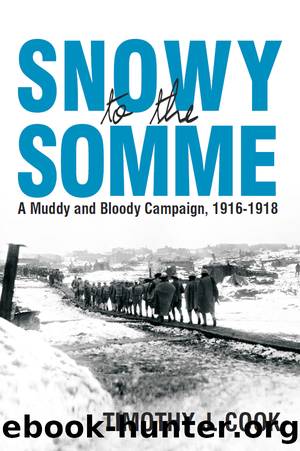
Snowy to the Somme by Tim Cook
Author:Tim Cook
Language: eng
Format: epub
Publisher: Big Sky Publishing
Published: 2014-10-15T00:00:00+00:00
Chapter 11:
Villers-Bretonneux â âaltogether it was a very bad businessâ
The capitulation of Russia in late 1917 permitted the Germans to shift massive numbers of men from the Eastern to the Western Front. These reinforcements tilted the military balance in Germanyâs favour. General Erich Ludendorff who, along with Field Marshal Paul von Hindenburg, was the de facto political and military leader of Germany, realised that the American troops soon to arrive on the Western Front would completely negate this advantage. Ludendorff began planning a series of offensives to conclude the campaign on the Western Front before the arrival of the Americans became a decisive factor.
On 21 March 1918, the first and largest of these offensives, âOperation Michaelâ, was unleashed against the British forces south of Arras. The aim of âMichaelâ was to drive a wedge between the British and French armies then wheel north-west and push the British into the sea.
German artillery and storm troopers stunned the defenders. The British Third and Fifth armies were forced into a disorderly retreat. The French civilian population fled in panic. German troops advanced across the old Somme battlefields towards Amiens, a vital rail hub and the junction of the French and British forces.
To capture Amiens the Germans needed to pass through Villers-Bretonneux, a town situated on a low plateau which provided an uninterrupted view to Amiens 15 kilometres away. Four Australian divisions in the Ypres salient were told to prepare for a move south to reinforce the depleted British units defending Villers-Bretonneux; the 5th Division was one of these.
On the day âOperation Michaelâ was launched the 55th Battalion was resting near Wytschaete. Here the men received the news that, as part of the AIFâs policy of replacing British officers with Australians, the highly regarded Brigadier General Clarence Hobkirk was to hand over command of the 14th Brigade to 34-year-old Brigadier General âCamâ Stewart from Melbourne, Victoria.1
In the reserve areas, the unit settled into a semblance of out-of-the-trenches normality. While training and work parties kept the men occupied, their thoughts were ever on the battles raging to the south. Wild rumours circulated about the German offensive. Private Bert Bishop, on returning from leave, found âEveryone was uneasy, upset, a strange all-up-in-the-air feeling obsessed us all.â2
On the evening of 23 March, confirmation came that the entire brigade was to move to an unspecified destination. Private Eddie Street had no doubt where they were going, despite the absence of official clarification:
We knew it was the Somme for us again. Absolutely sure. Despite the catastrophe down south, the AIF were in great spirits, and morale was raising higher and higher ⦠We were feeling in great form, the mighty responsibility about to be thrust on us served to make us more confident.
Next morning the curtain of uncertainty was swept aside. Private Bishop related the manner in which news of the German successes were communicated:
âIâve just come from brigade,â said our [company commander] ⦠We crowded in more closely. The captainâs voice was calm, steady. âTo put it plainly ⦠the Germans have smashed through on a front of many miles.
Download
This site does not store any files on its server. We only index and link to content provided by other sites. Please contact the content providers to delete copyright contents if any and email us, we'll remove relevant links or contents immediately.
| Africa | Americas |
| Arctic & Antarctica | Asia |
| Australia & Oceania | Europe |
| Middle East | Russia |
| United States | World |
| Ancient Civilizations | Military |
| Historical Study & Educational Resources |
The Radium Girls by Kate Moore(12089)
100 Deadly Skills by Clint Emerson(4968)
Rise and Kill First by Ronen Bergman(4833)
The Templars by Dan Jones(4732)
The Doomsday Machine by Daniel Ellsberg(4538)
The Rape of Nanking by Iris Chang(4255)
Killing England by Bill O'Reilly(4041)
Stalin by Stephen Kotkin(4003)
Hitler in Los Angeles by Steven J. Ross(3974)
12 Strong by Doug Stanton(3575)
Hitler's Monsters by Eric Kurlander(3384)
The Code Book by Simon Singh(3249)
Blood and Sand by Alex Von Tunzelmann(3238)
Darkest Hour by Anthony McCarten(3161)
The Art of War Visualized by Jessica Hagy(3041)
Hitler's Flying Saucers: A Guide to German Flying Discs of the Second World War by Stevens Henry(2777)
Babylon's Ark by Lawrence Anthony(2716)
Tobruk by Peter Fitzsimons(2559)
The Second World Wars by Victor Davis Hanson(2553)
